 Crayon Compass Press
How to teach your child to blend sounds into words
Blending is the moment letter sounds slide together into a word: /s/ /a/ /t/ becomes sat. To teach it, say clean letter sounds with no extra "uh", play quick listening games out loud, then show your child how to stretch the sounds together under a written word. Most children get there with a few weeks to a few months of 5-minute daily practice. No teaching background needed.
A quick note on the slashes
In this guide, letters between slashes mean the sound, not the letter name. /s/ means say "sss", not "ess". /a/ means the short a in apple, not "ay".
Is my child ready?
Clean sounds and listening games (Steps 1 and 2) need no letters at all, so you can start those any time. Your child is ready to blend written words (Step 3) when they know six to eight letter sounds, for example s, a, t, p, i and n, including a short vowel or two (a as in apple, i as in itch). They do not need the whole alphabet first. Learning new letter sounds and practicing blending work best side by side.
Step 1: say clean, "pure" sounds
Drop the extra "uh" at the end of each sound: say "mmm" for /m/, not "muh", and a quick, quiet /t/ or /p/, not "tuh" or "puh". Extra "uh" sounds make blending much harder, because "tuh-a-puh" does not sound like tap.
- Start with stretchy sounds you can hold: /m/, /s/, /f/, /l/, /n/ and the short vowels (a as in apple, e as in egg, i as in itch, o as in octopus, u as in up). "Sssuuunnn" slides straight into sun.
- Save words that start with a quick sound like /b/, /d/, /g/, /k/, /p/ or /t/ for a little later. You cannot stretch the first sound of bat or tap, so they are harder to start with. A quick sound at the end, as in sat, is fine.
Step 2: play blending games with no letters
Blending starts with the ears. Try "slow-motion talk": say a word slowly, stretching the sounds, and let your child guess it.
- "Can you touch your /l/ /e/ /g/?" ("llleeeg": leg)
- "I spy the /s/ /u/ /n/." ("sssuuunnn": sun)
- "Pass me the /m/ /u/ /g/." ("mmmuuug": mug)
Two minutes a day in the car or at bath time is plenty. Later, your child may enjoy swapping roles and splitting a word into sounds for you. Keep that optional: splitting words apart is harder than putting them together. If your child already knows six to eight letter sounds, you do not need to wait. Warm up with two listening words and go on to Step 3.
Step 3: sound it out, then slide it together
Write a short word like sat in large lowercase letters. Most words in books are lowercase, so skip the capitals.
- Show one first. Point under each letter as you stretch the sounds without stopping, "sssaaat", then sweep your finger under the word and say "sat!"
- Your child's turn. They touch under each letter and say its sound, then slide a finger from left to right, joining the sounds: "sssaaat".
- Say it at normal speed. Ask, "What word is that?" Then use it in a sentence together, so the word means something.
If the three sounds will not join up, blend in parts. Cover the t with your finger so your child blends /s/ and /a/ into "sa". Then uncover the t: "sa... t, sat!" Many children find this much easier than holding three sounds in mind at once, especially on words that start with a quick sound, like tap ("ta... p").
Good starter words using only s, a, t, p, i and n: start with stretchy first sounds (sat, sap, sit, sip, nap), then try quick first sounds (pat, tap, pit, tip, pin, tin, pan). Once more letters are known: man, mat, sun, fin, lip, leg, mop.
Skip three-letter words that do not sound out the usual way, like was, the, saw, car, cow and boy. They come later.
A 5-minute daily routine
- Warm up (1 min): two or three slow-motion words out loud.
- Read words (3 min): four to six short words using only letter sounds your child knows well.
- Read one sentence (1 min), once single words are going well: for example "Pat sat in a tin." Just tell your child the word "a". In a sentence it usually sounds like "uh", not like the a in apple. Words like this are often called tricky words: sound out the regular parts and just tell your child the unexpected sound, a few words at a time.
Stop while it is still fun. A short session every day works better than a long one once a week.
Common snags and what to do
- Says the sounds, but a different word comes out (s-a-t, "sit"): if the middle sound was wrong, point back to that letter and check its sound. If all three sounds were right, the pauses between them were too long. Help your child stretch the sounds together without stopping: "sssaaat".
- Guesses from the first letter or the picture: cover the picture while they sound out every letter, left to right, then uncover it to check. Praise the sounding out, not just the right answer.
- Adds "uh" to every sound: model the clean sound again, and practice words that start with stretchy sounds (sat, man, sun) before words that start with quick sounds (bat, dog, tap).
- Gets upset or stuck for days: go back to listening games for a week. Blending clicks at different ages, and a break is not a step back. If your child is 6 or older, or near the end of kindergarten, and still finds blending very hard after a couple of months of gentle practice, talk to their teacher about extra support.
What to read once blending clicks
When it is your child's turn to read, choose decodable books: books that only use the letter sounds your child has learned, plus a few taught tricky words. That way they can read every page by sounding out instead of guessing. Keep reading picture books aloud to them too, just for fun. That is where new words and a love of stories come from. Our reading levels guide shows which of our decodable books fits each stage.
Questions parents ask
At what age do children learn to blend?
Most children learn to blend sounds between ages 4 and 6, usually in pre-K or kindergarten, once they know a handful of letter sounds. Some get it in a few days and some take a few months. Both are normal.
Should I teach letter names or letter sounds first?
For reading, letter sounds matter most, because children blend sounds (sss-aaa-t), not letter names (ess-ay-tee), to read a word like sat. Children can learn the names alongside, as long as practice focuses on the sounds.
How long should blending practice be?
About 5 minutes of blending practice a day is plenty for children ages 4 to 6. Short, daily and playful sessions work much better than long, occasional ones.
My child can blend words out loud but not when reading. Why?
Reading adds two jobs at once: remembering each letter's sound and holding the sounds in mind. If a letter takes a few seconds to recall, the first sounds fade before the child can join them. Practice quick letter sounds on their own, use only letters your child knows well, and blend in parts: join the first two sounds (/s/ and /a/ make "sa"), then add /t/ (sat).
My child knows letter sounds but can't blend. What should I do?
This is very common, and it usually clicks with short daily practice. Check that your child says each sound quickly and cleanly, with no extra "uh" ("mmm", not "muh"). Play blending games out loud with no letters. Then start with two-sound words like am, at, in and it, and words that begin with a sound you can stretch, like sat, before words like tap. Blend in parts: join the first two sounds, then add the last. If your child is 6 or older and still stuck after a couple of months, talk to their teacher.
Books for this stage
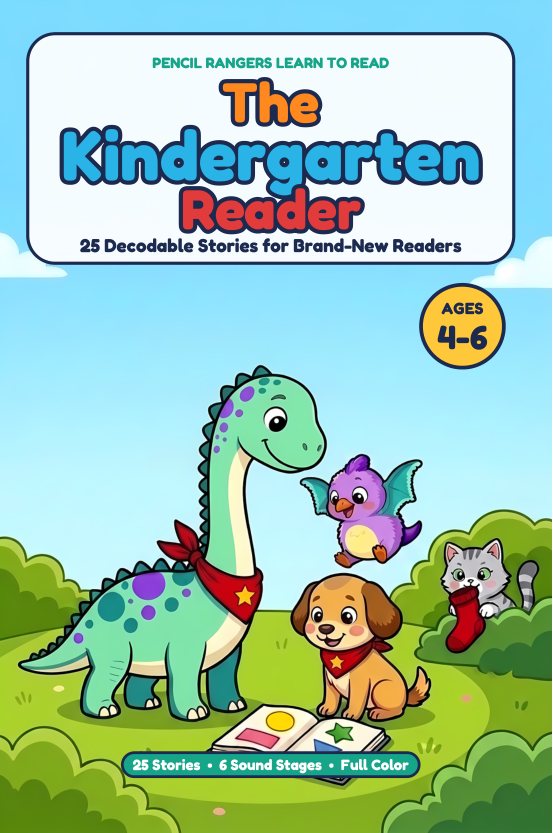 The Kindergarten ReaderAges 4 to 6, paperback and Kindle
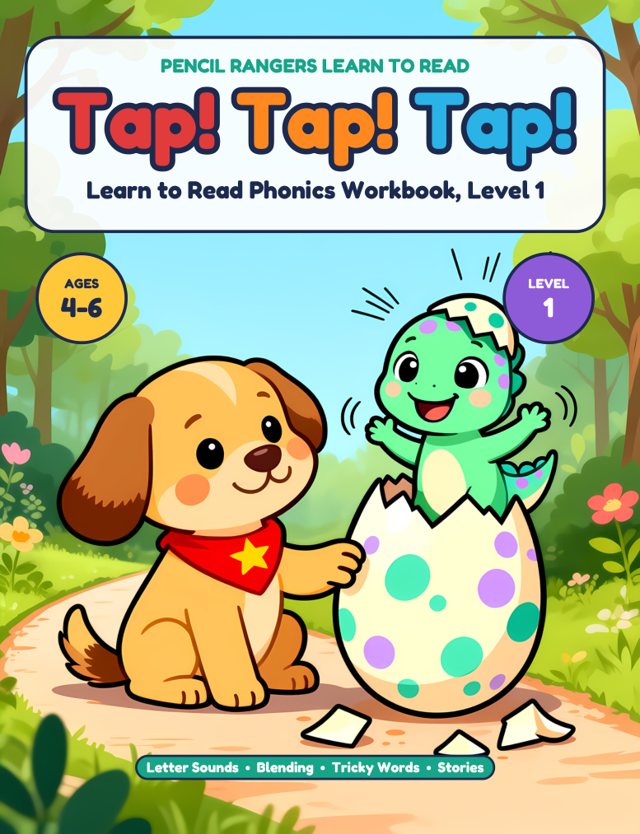 Tap! Tap! Tap! Phonics WorkbookAges 4 to 6, paperback
Written by the Crayon Compass Press team with help from AI, and checked by a person. How we work. Published 2026-11-13.